
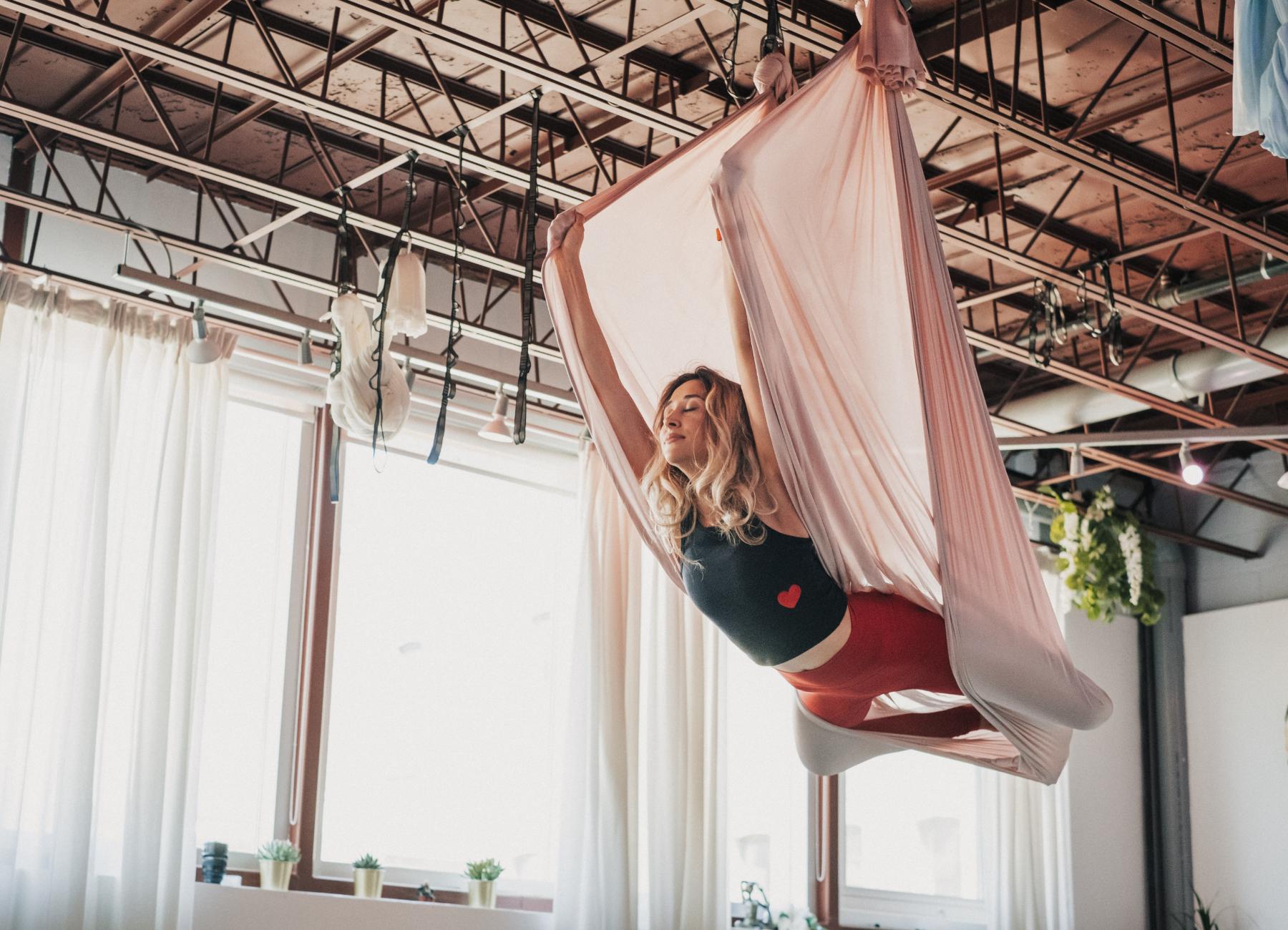
Ceilings rarely become part of a workout, yet silk hammocks suspended overhead change how the body learns to move. Aerial yoga invites people to step off the mat and train in three dimensions instead of two. In Toronto, this style of practice blends strength, coordination, and control in ways that challenge muscles many never knew needed attention.
What Aerial Yoga Does for Deep Core Muscles
Traditional floor exercises target visible abdominal muscles, but suspension work reaches deeper layers. The body must stabilize itself in every direction while supported by fabric. That demand activates transverse abdominal muscles and smaller stabilizers around the spine that rarely engage fully during standard crunches or planks. The hammock does not hold the body still; it invites subtle movement that the core must control.
Because gravity pulls from different angles, the midsection responds with steady engagement. Each lift, tilt, and inversion asks the torso to resist rotation and maintain alignment. Over time, this consistent activation builds endurance in deep muscles that support posture and protect the lower back. Students often notice that everyday tasks feel easier because their core no longer relies on surface strength alone.
How Suspension Work Builds Steady Balance
Standing on the ground offers predictable feedback. Suspended practice removes that certainty and introduces controlled instability. The body adapts by strengthening small muscles in the feet, ankles, and hips that help maintain equilibrium. This response improves balance without relying on rigid tension.
Balance improves because the nervous system learns to adjust quickly. Each shift in the hammock prompts a reflex that stabilizes the body before it drifts too far. These fast corrections build confidence and sharpen coordination. Practitioners discover that standing on one leg or walking on uneven surfaces becomes more natural with continued training.
Understanding Body Control in mid Air Poses
Mid air poses require focus and timing. The body cannot rely on momentum alone because every movement affects alignment. Controlled lifts and transitions demand awareness of where limbs are positioned in relation to the fabric. That awareness strengthens the connection between mind and muscle.
Precision grows with repetition. Students learn to engage the right muscles at the right moment to prevent swinging or twisting. This type of body control translates into improved athletic performance and daily stability. Even simple actions, like reaching or bending, begin to feel more deliberate and balanced.
Why Grip Strength Improves with Silk Support
Silk hammocks provide both support and challenge. Hands must hold, adjust, and guide the fabric during transitions. That repeated engagement strengthens fingers, wrists, and forearms without the need for traditional weightlifting tools.
Grip strength builds gradually. As students hold poses and adjust their position, the muscles in the hands and arms respond by increasing endurance. Stronger grip improves performance in other activities as well, from carrying groceries to participating in sports. Over time, the hands become reliable anchors during more advanced sequences.
The Role of Controlled Movement in Core Stability
Fast motions can mask weak stabilizers. Aerial practice emphasizes slow, deliberate transitions that demand steady engagement. Each controlled lift or rotation keeps the torso active rather than relying on momentum.
Consistency in these movements strengthens the entire midsection. The body learns to brace effectively before changing direction. That skill supports spinal stability and reduces unnecessary strain. As practice continues, stability becomes second nature rather than something forced.

Signs Your Posture Is Getting Stronger over Time
Improved posture does not appear overnight. Small changes often show up first in how shoulders rest and how the neck aligns. Students may notice they sit taller without conscious effort. Muscle endurance supports these shifts. Stronger back and core muscles hold the spine in a neutral position with less fatigue. Daily activities such as working at a desk or walking long distances feel less taxing. Gradual improvement signals that the body is learning to support itself efficiently.
How It Affects Joint Support and Alignment
Joint alignment benefits from balanced muscle engagement. Suspension work encourages even activation across both sides of the body. When muscles strengthen evenly, joints track more smoothly through their range of motion.
Improved alignment reduces uneven wear on knees, hips, and shoulders. By training stabilizing muscles, aerial yoga helps distribute force evenly. This approach supports long-term joint health and reduces the risk of strain caused by imbalance.
Indicators Balance Is Improving Through Practice
Progress appears in subtle ways. Students may find they wobble less during transitions or recover quickly from small shifts. Confidence replaces hesitation as movements become fluid.
Balance gains extend beyond the studio. Walking across slippery sidewalks or stepping off curbs feels steadier. With continued practice, the body reacts calmly instead of stiffening. These indicators show that balance is improving through consistent effort.

Elevate Your Strength and Stability with AT OM Yoga in Toronto — Build Core Power, Balance, and Confidence in Every Session
Training in the air offers more than a unique experience; it reshapes how the body understands strength and control. AT OM Yoga in Toronto provides structured classes designed to guide students safely through suspension techniques that build endurance, balance, and coordination. Each session focuses on steady progression, allowing beginners and experienced practitioners alike to grow at a comfortable pace.
Dedicated instructors create a supportive space where improvement happens naturally. From the first lift into the silk to more advanced inversions, students receive guidance that promotes safe movement and lasting results. Step into a new dimension of fitness and feel the difference in your core, posture, and stability. Contact us today to begin your aerial yoga journey with AT OM Yoga.
FAQs:
1. Do I need prior yoga experience to join AT OM Yoga classes?
No previous yoga experience is required to get started. Classes are structured to guide beginners step by step while still offering options for more advanced students. Instructors provide clear cues and hands-on guidance so everyone feels supported.
2. Is aerial yoga safe for beginners?
Aerial yoga is safe when taught by trained instructors in a controlled studio setting. AT OM Yoga focuses on proper technique, gradual progressions, and secure equipment setup. Students learn how to enter and exit poses safely before attempting more advanced movements.
3. What should I wear to an aerial yoga class?
Fitted clothing that covers the backs of the knees and underarms works best. This helps protect the skin from the silk fabric and allows smoother transitions between poses. Avoid zippers, jewelry, or anything that could snag the material.
4. Will aerial yoga help improve strength and flexibility?
Yes, aerial yoga challenges both strength and flexibility at the same time. The suspended movements activate deep core muscles while encouraging longer, supported stretches. Over time, students often notice better balance, posture, and overall body control.
5. How often should I attend classes to see results?
Attending two to three classes per week can lead to steady improvement. Consistency allows the body to adapt to new movement patterns and build endurance. Many students begin to feel stronger and more balanced within a few weeks of regular practice.


