

If you’ve ever seen someone gracefully suspended in a hammock mid-air, spinning and stretching like it’s second nature, you’ve probably wondered how they got there. What you didn’t see? The months of specific, deep training that sculpted that control. Training in aerial yoga, flying yoga, and pilates doesn’t just look impressive—it builds instructors who are strong, aware, and ready for anything. Here’s how the process transforms passionate movers into confident leaders.
Builds Core Strength and Stability for Aerial Yoga and Pilates Teaching
The core isn’t just your abs—it’s the command center for every movement. Training in aerial disciplines locks focus onto those deep stabilizing muscles that often get overlooked. Instructors learn how to engage their core not only for dramatic movements but also for subtle control. Holding a position mid-air or slowly pulling through a suspended pose requires constant engagement, which builds lasting strength that translates into grounded and powerful instruction.
For pilates movements, that same core control becomes even more precise. When combined with the hammock, each shift in body weight asks the instructor to resist gravity, align intentionally, and move with total control. That experience sharpens their body awareness, creating instructors who move with purpose and guide with clarity.
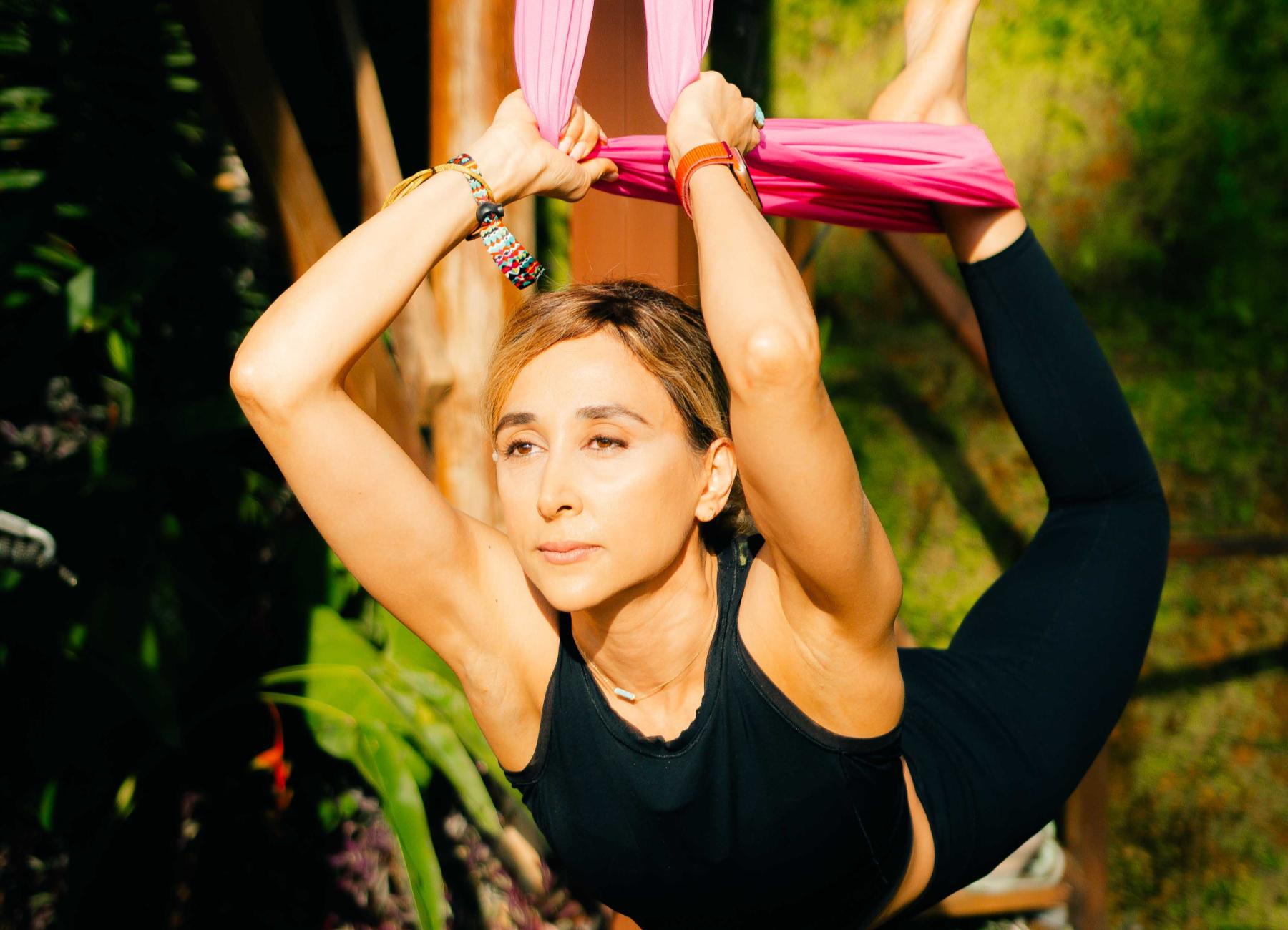
Enhances Balance and Body Awareness for Safe Flying Yoga Instruction
Balance isn’t about staying still—it’s about adjusting quickly. In flying yoga training, instructors practice shifting between dynamic poses, suspended twists, and airborne flips. These unpredictable transitions improve coordination and teach the body how to stay centered even in motion. That awareness makes instructors better at spotting wobbles and correcting posture in others.
Body awareness also helps instructors cue more effectively. After spending hours learning how every tilt of the pelvis or angle of a foot affects a suspended pose, they develop a deep understanding of the body’s mechanics. That insight allows them to communicate details clearly, keeping students safe while encouraging growth.
Improves Flexibility and Joint Mobility to Lead Diverse Aerial Yoga Classes
Flexibility isn’t just about touching your toes—it’s about opening the body to move freely. Training for aerial yoga demands attention to shoulders, hips, spine, and everything in between. Instructors increase their range of motion by gradually easing into deep stretches that hammocks can support without force. The result is flexibility that’s functional and balanced, not just showy.
Joint mobility gets a major upgrade too. By using the hammock to support and challenge the joints, instructors develop a strong sense of how far they can move without strain. That helps them teach a wide range of students, from beginners to more advanced, and offer meaningful adjustments based on mobility and comfort levels.

Boosts Confidence Through Mastering Hammock Inversions and Transitions
Nothing flips a mindset like hanging upside down on purpose—and nailing it. Inversions teach instructors to trust their strength, breath, and technique. Whether it’s a controlled drop or a silent spin, these skills create a powerful sense of capability. That confidence doesn’t stay in the air—it carries into every class, helping instructors command the room with ease.
Mastering transitions builds even more assurance. Seamless movements from pose to pose require planning, rhythm, and physical memory. Training pushes instructors to refine these sequences until they flow effortlessly. As a result, they gain not only technical skills but also the self-trust that comes with overcoming fear and building control from the inside out.
Trains Instructors in Safe Rigging and Spotting Skills for Flying Yoga Safety
Training doesn’t stop at movement—it includes equipment mastery. Instructors learn the rigging process, knot work, and load limits necessary to keep everything safe above ground. In flying yoga, this hands-on knowledge ensures that each setup meets safety standards and supports the unique flow of the class.
Spotting is just as essential. Instructors develop techniques to assist students physically and verbally through tough transitions. They learn how to keep others safe without interrupting the flow of the class, knowing exactly when to step in and when to let students explore. These skills make their teaching more secure and more professional.

Strengthens Teaching Skills for Mixed-level Students in Aerial Yoga Classes
No class looks the same twice. One day, there’s a seasoned mover and a hesitant newbie sharing the same space. Training prepares instructors to manage that gracefully. They learn how to build class flows that allow variation, offering grounded options and advanced transitions in the same sequence. It’s part of what makes aerial yoga instruction both challenging and rewarding.
Communication plays a big part too. Instructors work on refining their verbal cues to match each student’s level without overwhelming anyone. They grow comfortable giving hands-on assists and adapt on the fly to shifting classroom energy. This practice ensures they’re prepared for every personality and every skill level.
Combines Pilates and Yoga Foundations for a Well-rounded Aerial Yoga Approach
The power of this training lies in its blend of traditions. Where yoga brings breath, alignment, and introspection, pilates adds targeted strength work and controlled precision. The hammock becomes a tool to explore both styles, helping instructors build balanced classes that go beyond one philosophy.
The combination makes instruction more layered. One moment might call for stillness and breath; the next, a fierce core circuit mid-air. Instructors learn to mix these approaches in creative ways that challenge students physically and mentally. This range makes their classes dynamic and fresh.
Prepares Instructors to Adapt Routines for Flexibility, Strength, and Flow in Aerial Yoga
Every student brings a different body, and every day brings a different mood. Training teaches instructors how to pivot. If a class needs more softness, they know how to swap a strength series for gentle aerial stretches. If energy’s high, they can amp up the inversions. Flexibility in lesson planning becomes second nature.
This adaptability also shows in how they handle the unexpected. A tight hamstring, a nervous student, or a limited space—none of these throw off a well-trained instructor. Instead, they respond with confidence and creativity, keeping flow intact and experience positive. That’s what sets apart instructors who thrive from those who just get by.
AT OM Yoga Builds More Than Instructors—It Shapes Bold, Resilient Leaders Ready to Soar
Becoming an aerial instructor isn’t about tricks in the air—it’s about transformation from the ground up. AT OM Yoga delivers a training experience that nurtures confidence, sharpens technique, and builds leadership in the sky and beyond. Graduates leave not just with certification, but with a toolkit for supporting others and themselves through movement, challenge, and growth.
From rigging safety to sequencing for every body type, AT OM Yoga covers every detail. The result? Instructors who move with clarity, speak with confidence, and guide with heart. If you’re ready to rise into your full potential and lead from a place of strength and knowledge, contact us to begin your teaching training journey today.


